Bradley Brooke Appeal Denied
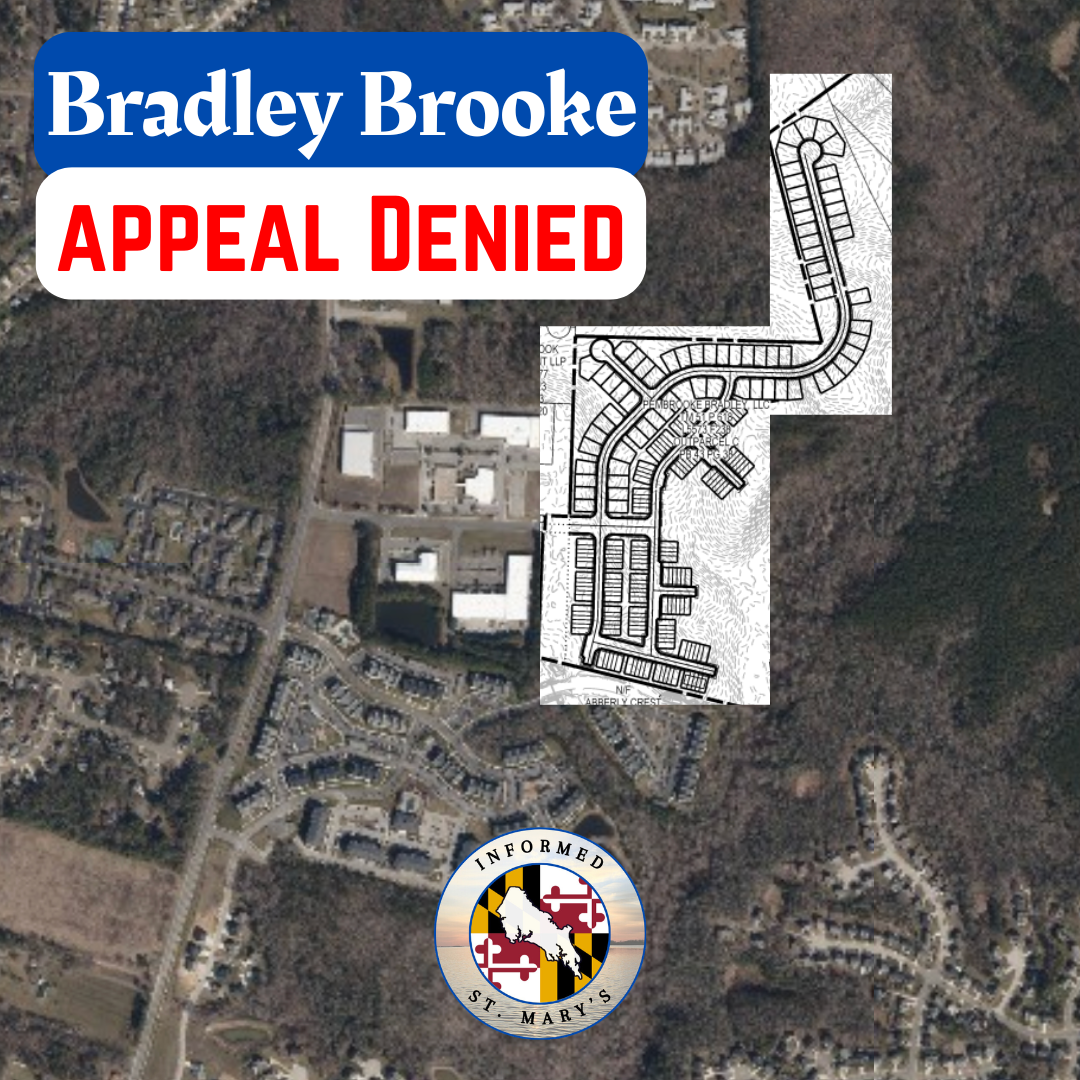
After two lengthy meetings, the Board of Appeals unanimously denied the proposed Bradley Brooke subdivision on April 23. The plan called for a 223-unit residential development off Willows Road. The Planning Commission previously denied the project in February.

Chris Longmore, attorney
According to documents filed by the developer’s attorney, Chris Longmore, the Planning Commission “considered information that was not within the record,” including “the personal opinions and experiences of individual” commission members. Longmore also argued the commission “considered information … that was irrelevant to the application,” such as future “potential changes in law.”
That argument centered on noise contours within the Accident Potential Zone, which encompasses flight paths used by aircraft at Naval Air Station Patuxent River. The county’s current noise contours were adopted in 2009, but a subsequent study updated those contours in 2019. The updated contours have not been incorporated into the county’s zoning ordinance, which must be approved by the County Commissioners.
The dispute focused on differences between the 2009 and 2019 maps. Navy guidance discourages development in areas with noise levels of 65 decibels or higher. Under the 2009 contours, none of the proposed development fell within the discouraged zone. The 2019 contours, however, expand higher-noise areas to include locations where more than 20 homes would be built.
NAS Patuxent River Commanding Officer Capt. Mark Zematis testified that the Navy prefers development not to occur in higher-noise areas. An updated Air Installation Compatible Use Zone study is expected this summer and could revise development recommendations around the base. The study would still need to be incorporated into county zoning ordinances and approved by the County Commissioners, a process that could take several years.
The Board of Appeals hears cases “de novo,” meaning it does not consider the Planning Commission record and instead reviews evidence independently. Board members submitted more than a dozen pages of questions to the applicant, the Navy and county agencies in advance of the hearing, focusing on traffic, school capacity, bus stops and potential impacts to the base.
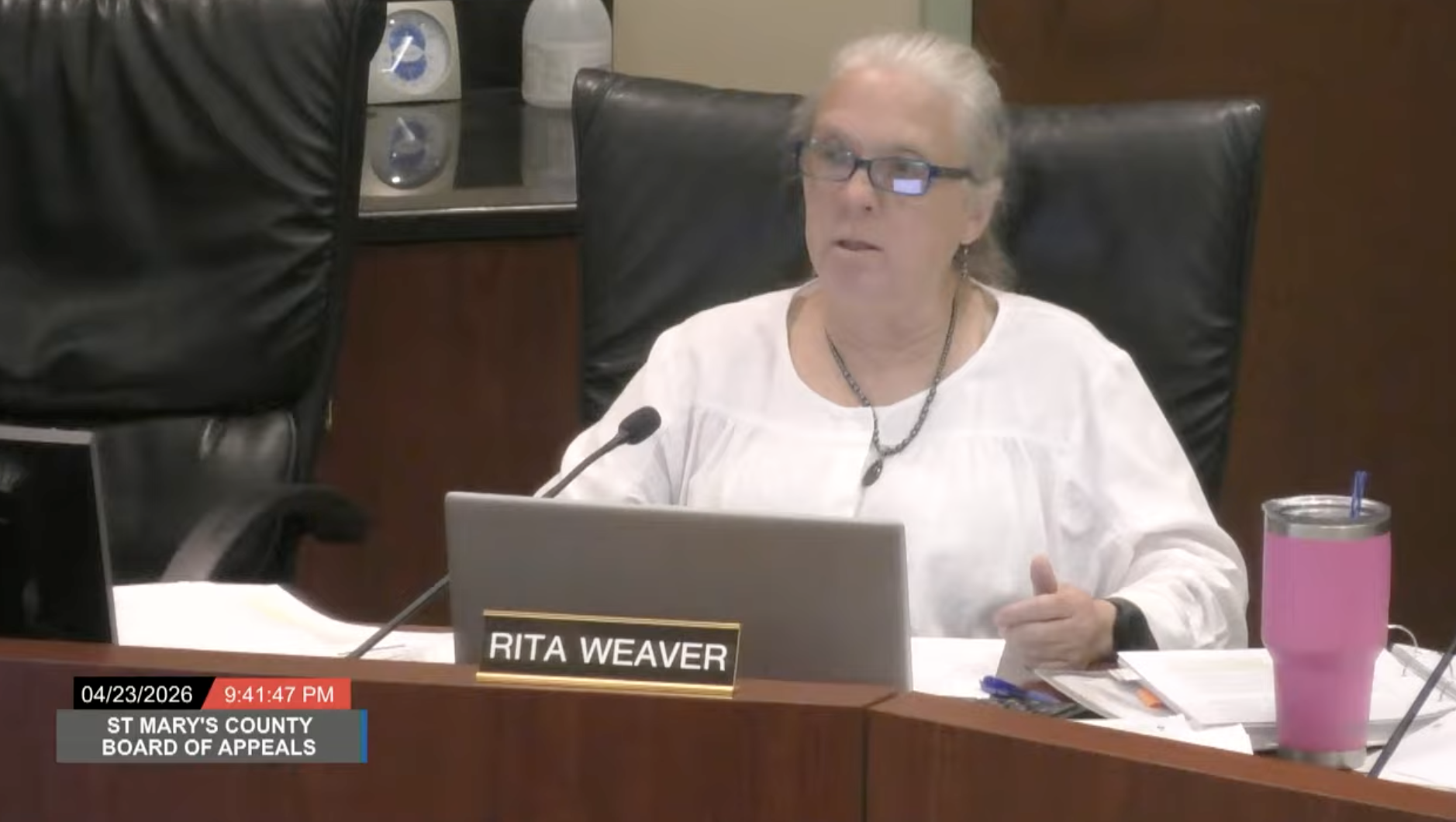
Rita Weaver, board member
Board member Rita Weaver, a former Board of Education member, raised concerns about school capacity amid recent development approvals. Kimberly Howe, director of capital planning for St. Mary’s County Public Schools, said determinations of adequate capacity are made by the Department of Land Use and Growth Management based on school system data. Howe said existing capacity is insufficient to meet demand from five previously approved projects.
“The best we can do is react to the development that happens, and we can add relocatables or redistrict,” Howe said. She noted the county’s Adequate Public Facilities Ordinance allows schools to exceed state-rated capacity.
Board members also discussed a provision of the county’s subdivision ordinance, adopted in August 2010, stating that subdivisions with more than 75 dwelling units generally must have more than one entrance. The applicant cited other county neighborhoods with a single entrance and said no feasible alternative exists due to surrounding development and environmental constraints.
The single-entrance design drew concern from all board members. The applicant said traffic could be rerouted through nearby business parking lots if the main entrance on Bradley Boulevard were blocked, but no formal agreements with those businesses were presented.
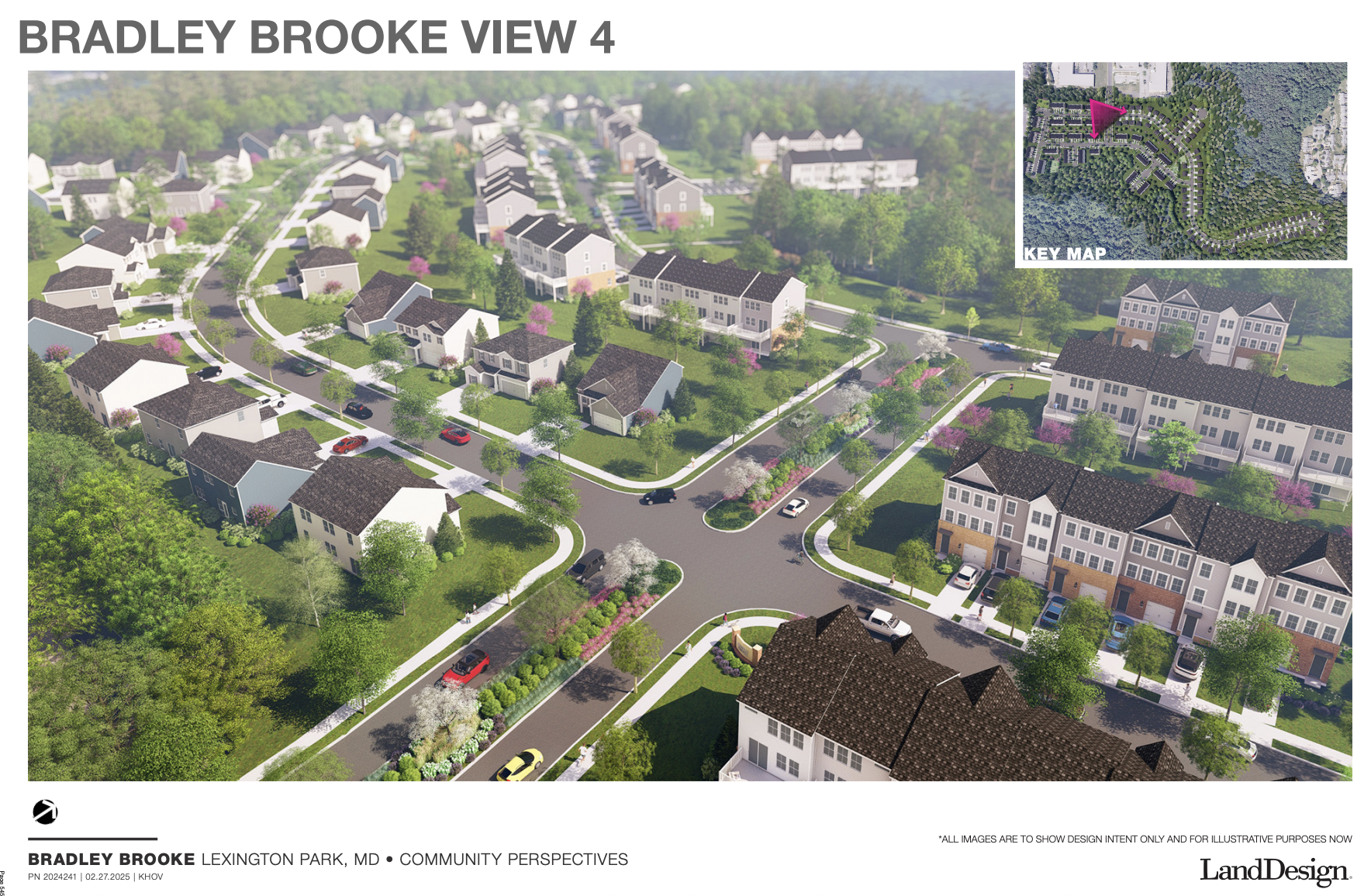
from concept rendering
Under the proposal, roads serving single-family homes would become publicly maintained, while roads serving townhomes would remain private and maintained by a homeowners association. That would include parking enforcement, snow removal and general maintenance. Weaver cited a county regulation stating private roads should serve no more than seven lots, while the proposal would serve up to 30 townhome lots on private roads.
Board members raised concerns about on-street parking limiting emergency access. Townhomes typically include two parking spaces, one in a garage and one in a driveway, potentially leading to additional vehicles parking on the street.
Brandy Glenn, deputy director of Land Use and Growth Management, said the then-county attorney advised in 2017 that the seven-lot standard should not be applied to townhouse developments. That guidance, however, was not formally incorporated into the zoning ordinance.
At the conclusion of the hearing, Longmore said the project meets all applicable requirements under current county law, a position reflected in the staff report by Land Use and Growth Management.
The Board of Appeals ultimately denied the concept site plan and major subdivision application. Longmore asked the board not to deny the requested variance, citing restrictions on refiling similar requests within a set period, indicating a possible appeal to Circuit Court.
—————
Informed St. Mary’s remains paywall free for everyone with your support. Donate here to support this important work.