Commissioners Want to “Clairfy” Tax Authority Over Leonardtown
Four of the five St. Mary’s County Commissioners voted Feb. 10 to advance a public hearing on proposed amendments to the county’s excise tax ordinance — a move that could determine whether development inside the Town of Leonardtown must pay the county’s residential and commercial excise tax.
Commissioner Colvin cast the lone vote against. The motion, made by Commissioner Hewitt and seconded by Commissioner Ostrow, follows discussion about Leonardtown’s annexations and new housing development.
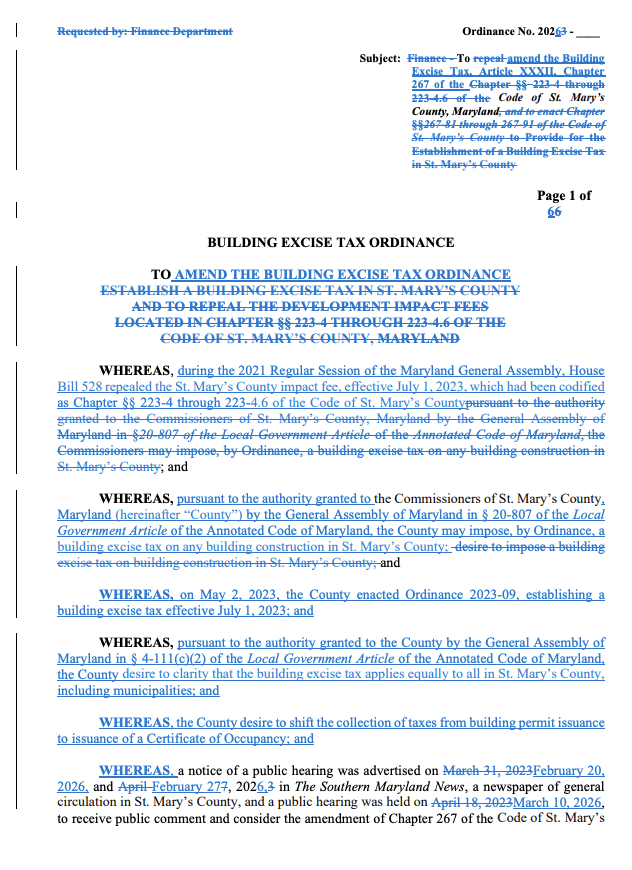
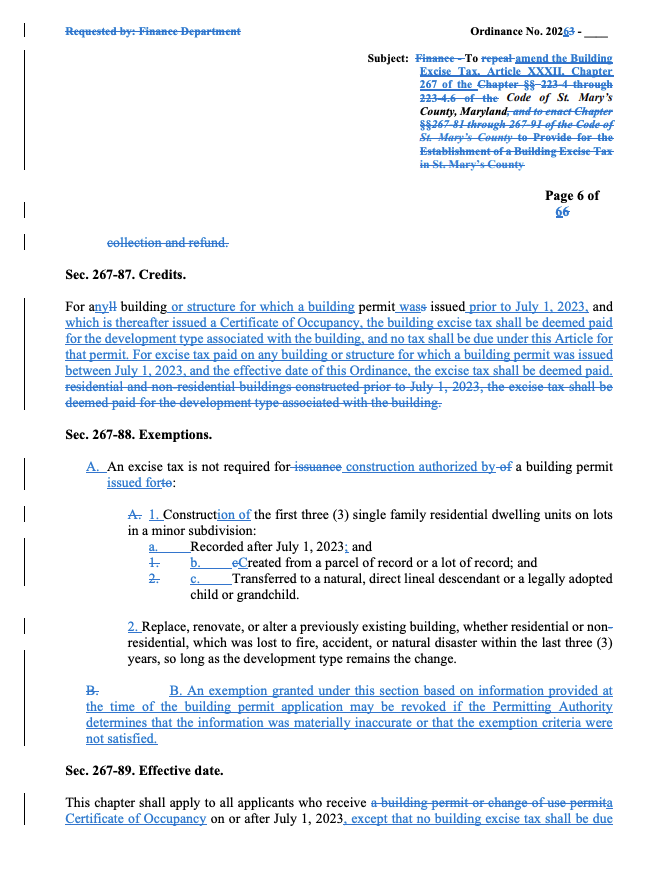
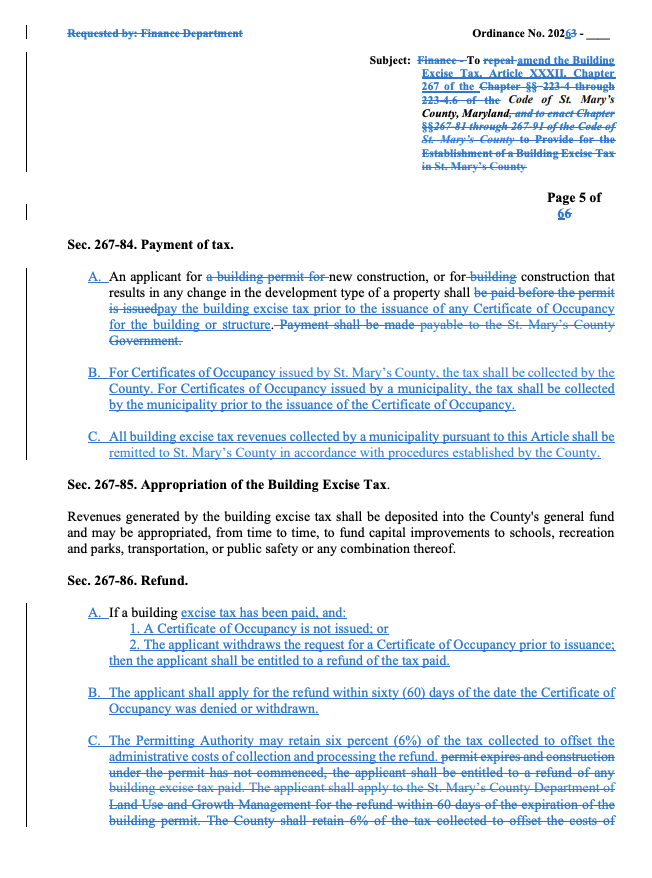
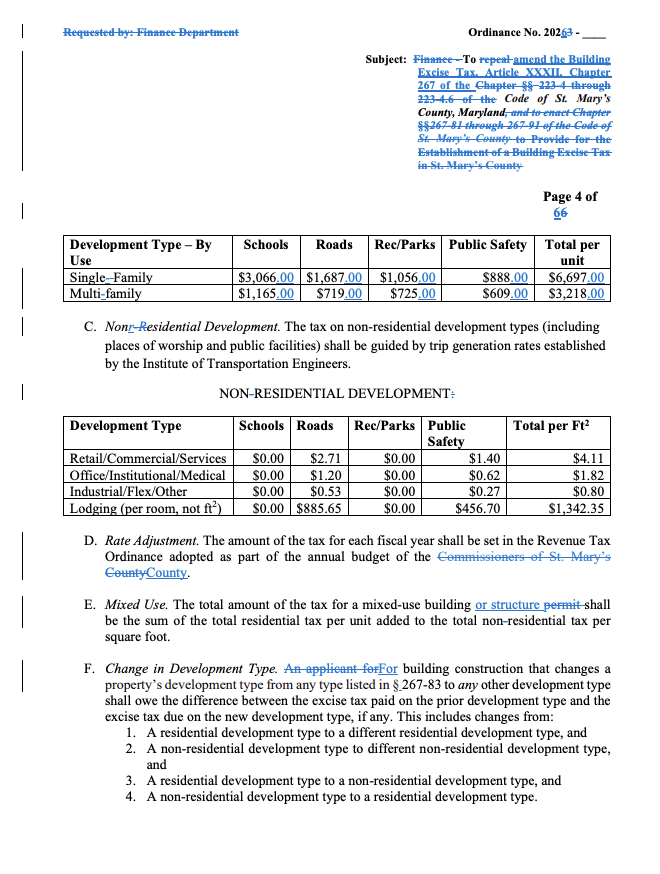
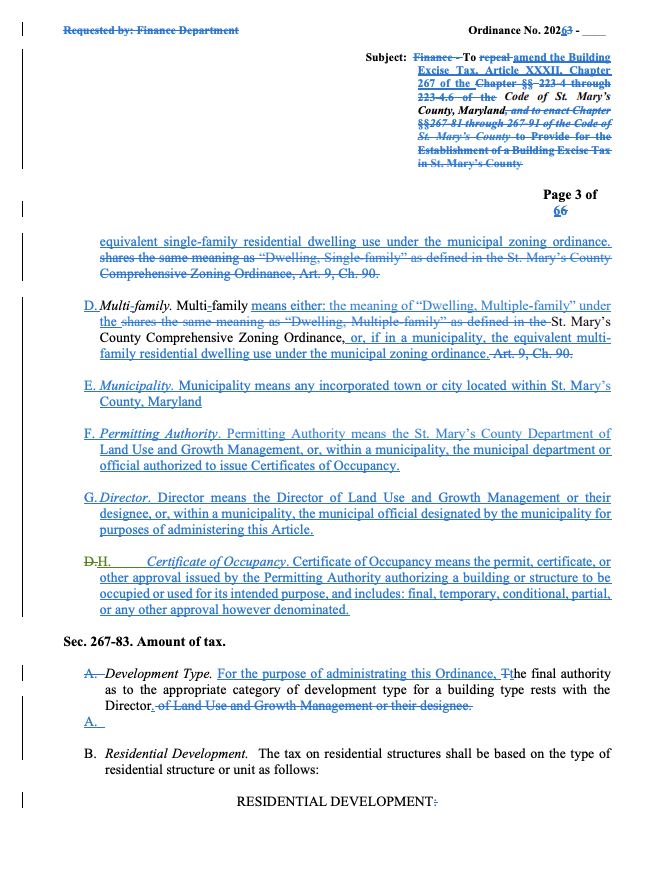
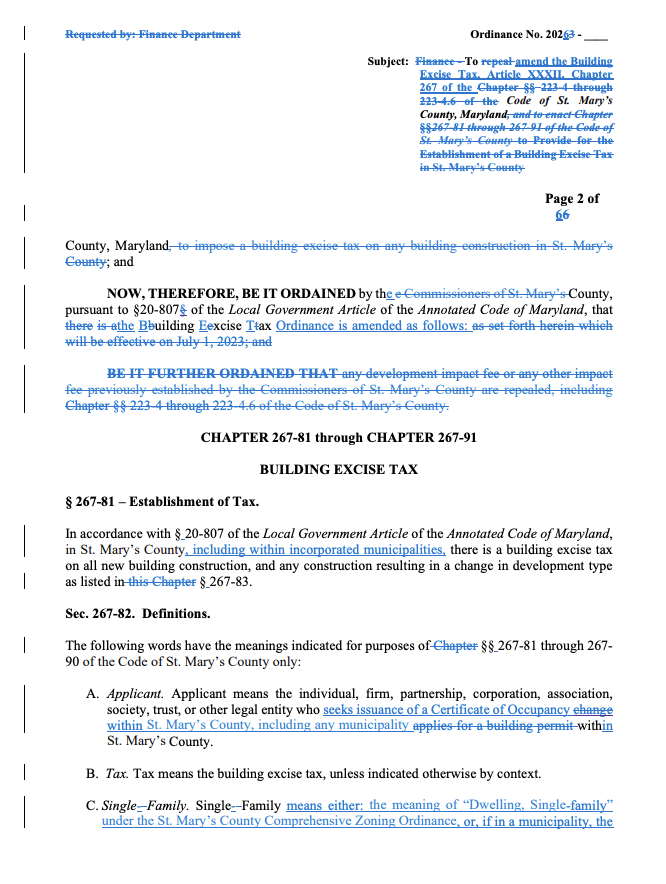
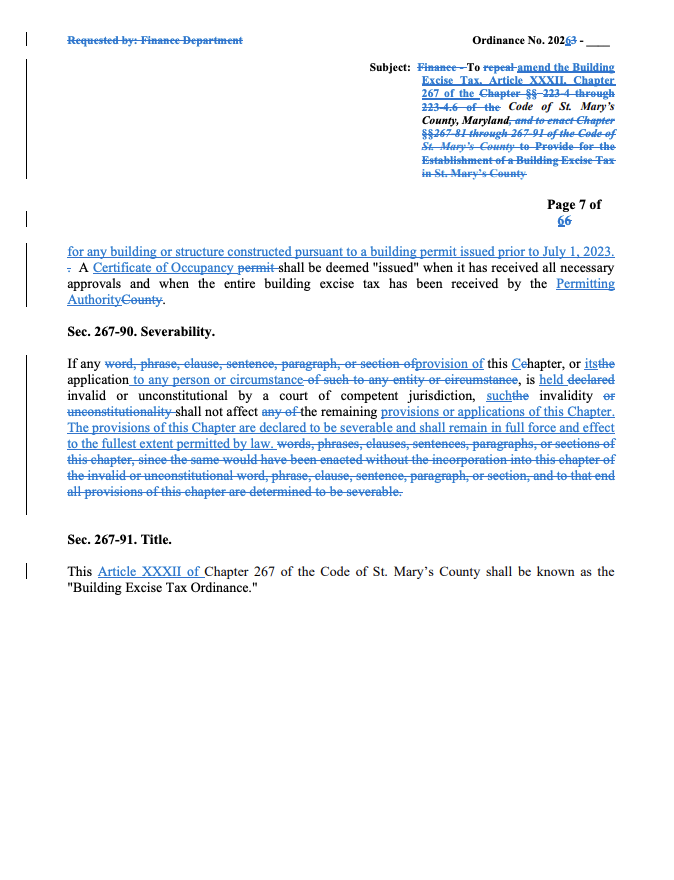
In December 2025, Hewitt (R-District 2) raised concerns that the county could lose millions in potential revenue if the excise tax does not apply to new development inside town limits. Residential and commercial construction elsewhere in the county must pay the fee. Hewitt has argued that disparity is unfair to residents outside Leonardtown and limits funding for schools, infrastructure and public safety. Some members of the Board of Education and the superintendent have echoed concerns about funding, noting the school system has not received excise tax revenue from town-based development.
The concern is tied in part to how annexation changes development potential. When farmland is annexed into Leonardtown, it is rezoned under the town’s zoning ordinance as Planned Urban Development. That designation allows for higher-density, master-planned residential communities. Neighborhoods such as Leonard’s Grant, Clark’s Rest and Meadows at Town Run were developed under those circumstances after annexation into the town.
Leonardtown officials dispute that characterization. In a Feb. 11 statement, Mayor Dan Burris said, “Leonardtown residents should not be required to pay twice for infrastructure services that the Town already provides.”
The disagreement highlights a broader policy question: whether development inside municipal boundaries should contribute to countywide infrastructure in the same way as development outside those boundaries.
Tensions between county and town officials date back to 2023, when the county repealed its long-standing impact fee and replaced it with an excise tax.
Beginning in 2000, the county charged a $4,500 impact fee per new residential dwelling unit. That fee remained unchanged until 2017, when a study found the true infrastructure cost of a new home was approximately $23,000.
The fee rose to $5,500 in 2018. But between 2018 and 2023, adjustments to the calculation formula reduced the effective amount charged. By 2023, commissioners had lowered the impact fee to about $2,000 per home. Those reductions contributed to insufficient funding for infrastructure, prompting adoption of the excise tax at $6,700 per new home.
By comparison, Calvert County charges nearly $13,000 per new home while Charles County charges just over $21,000.
Unlike the previous impact fee, the excise tax allows revenue for schools to be used more broadly for capital projects rather than strictly for capacity expansion. Public safety was also added as an eligible funding category. The tax also applies to commercial development, generating additional revenue.
Leonardtown charges its own impact fee for water and sewer infrastructure — roughly $24,000 per equivalent dwelling unit, according to a town release. Most of that fee funds upgrades to the town’s wastewater treatment plant, which expanded growth capacity in 2022. Both residential and commercial development pay that fee.
The town previously had a School Impact Fee ordinance requiring building permits for dwelling units to include a fee collected by the town and forwarded to the county upon issuance of an occupancy permit. When the county enacted the excise tax in 2023, the Leonardtown Town Council repealed its school impact fee ordinance.
Leonardtown residents pay property taxes to both the town and county, income taxes to the county, Fire/EMS taxes to support emergency services, and county support services and solid waste taxes.
Town property taxes fund roads, parks, public works and supplemental public safety services. Major roads within town limits — Routes 5 and 245 — are maintained by the Maryland State Highway Administration, while the town maintains neighborhood streets and roads around the square.
Town officials have warned that applying the county excise tax to commercial projects within Leonardtown would “significantly increase costs for small businesses, downtown redevelopment and infill projects.”
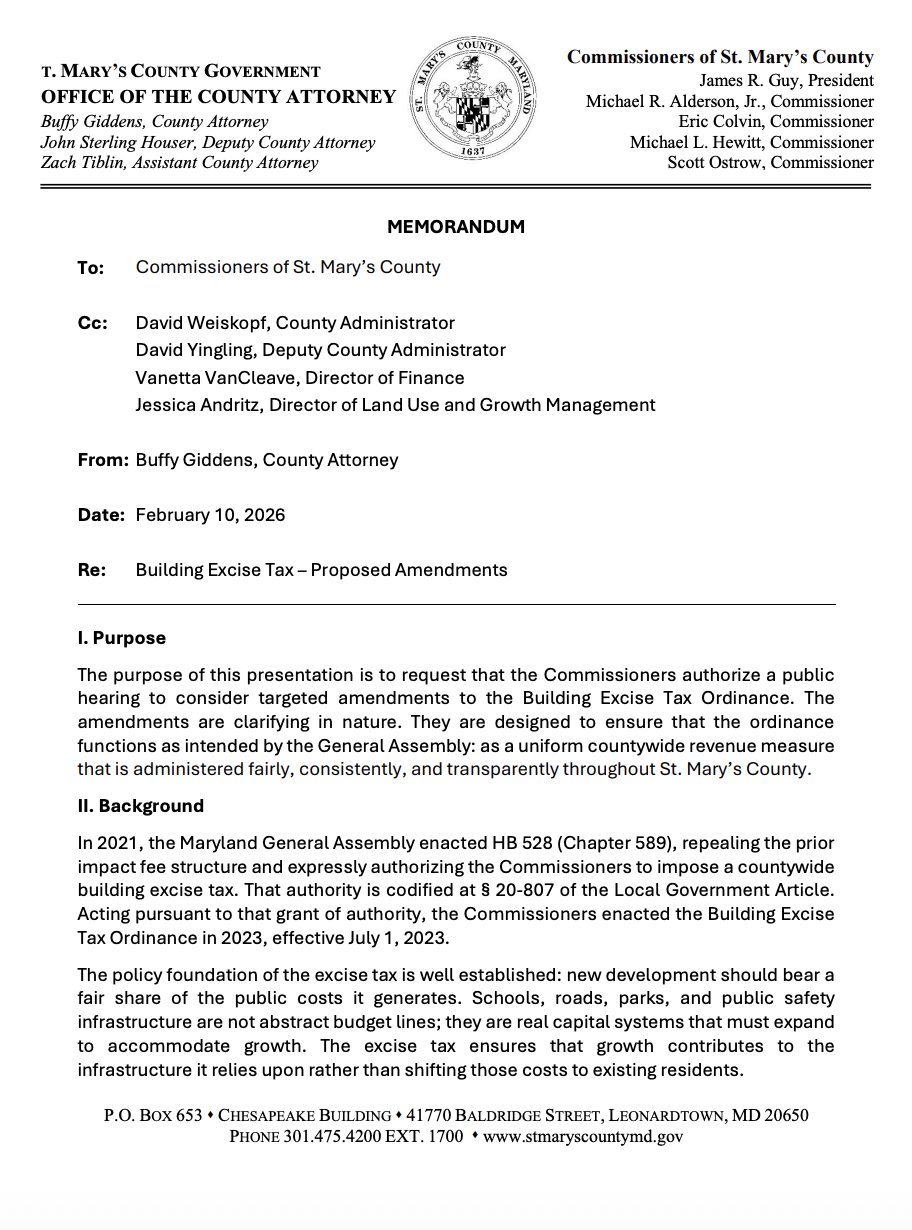
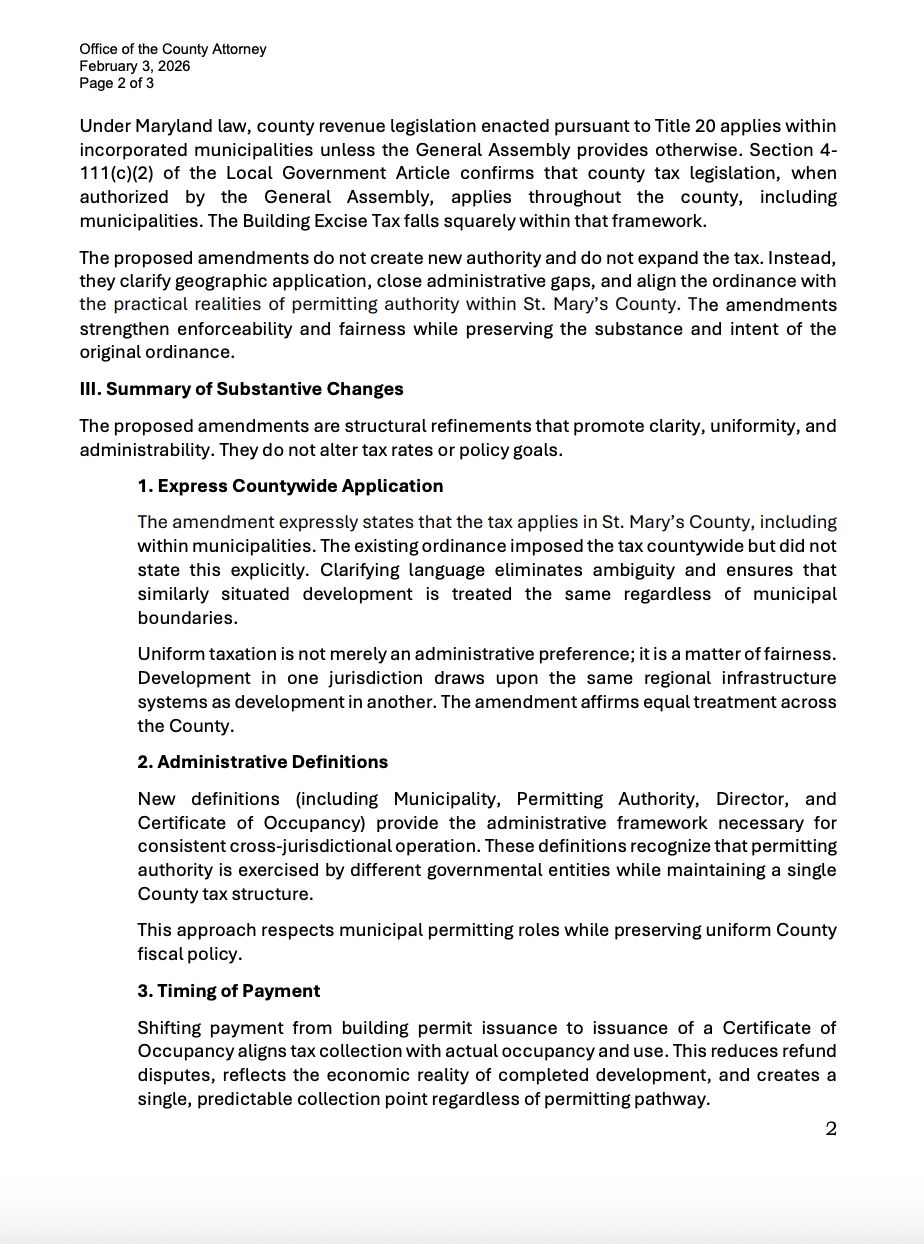
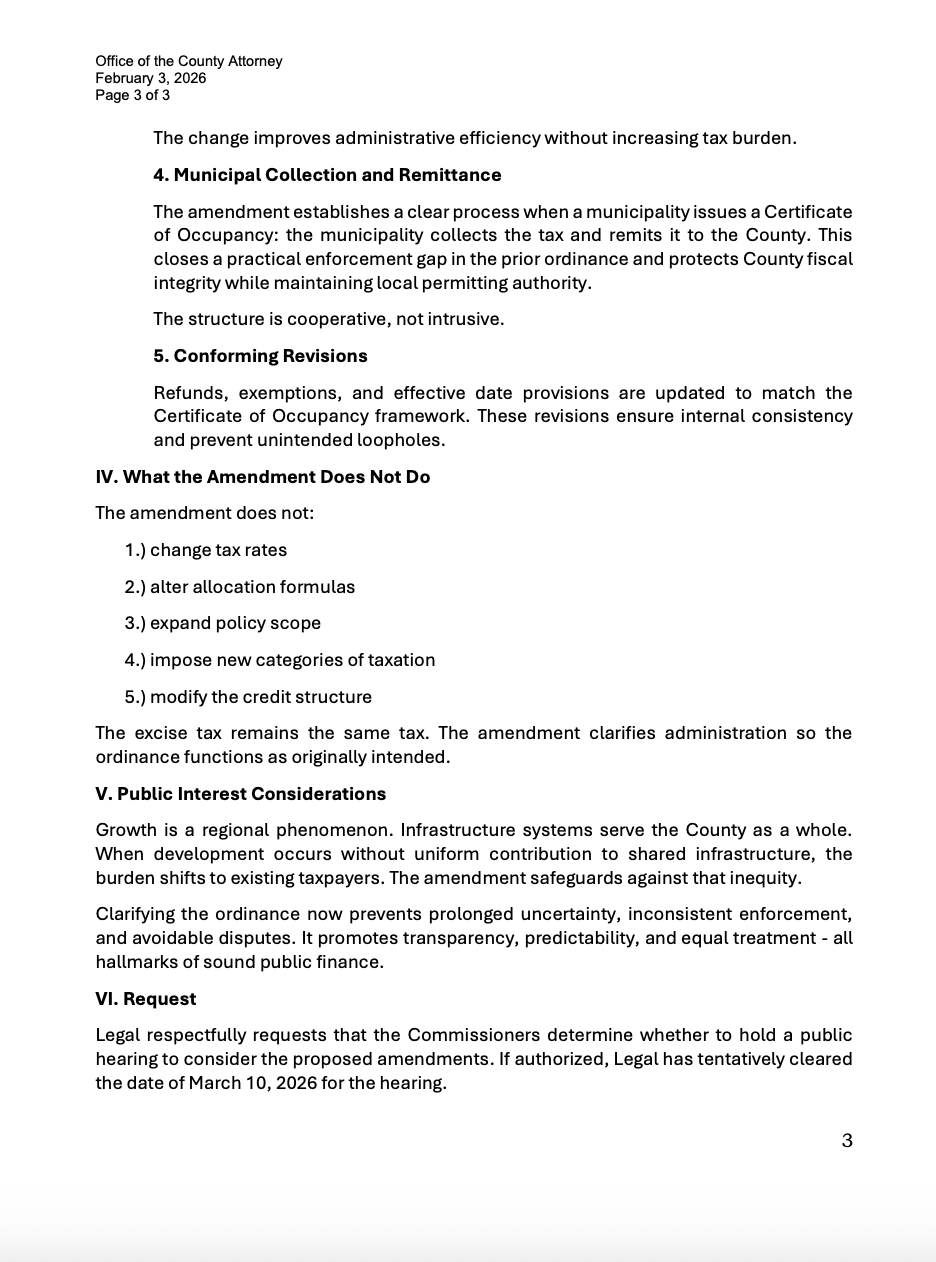
A memo from the County Attorney’s Office states the proposed amendments “promote clarity, uniformity and administrability” and “do not alter tax rates or policy goals.” The changes would explicitly state that the ordinance applies within municipal boundaries and establish a collection and remittance framework.
During the Feb. 10 discussion, Colvin (R-District 1) urged caution.
“This is a mistake,” he said. “The driving push behind this is a resentment toward any group that is showing success not under our control.” Colvin also said members of the state delegation, who authorized the county’s excise tax authority, did not intend for it to apply to Leonardtown.
Hewitt disagreed, calling Leonardtown a “boomtown” that is “annexing county property with limited building rights and developing them into large neighborhoods.”
Ostrow (R-District 4) said he could not justify telling residents in his district they must pay the excise tax while Leonardtown residents do not. “This is about making it fair and equitable,” he said.
Colvin made a motion to hold an evening public hearing and proposed cutting the excise tax in half. That motion failed, with Commissioner Alderson (R-District 3) voting in favor and Commissioners Guy (R-At Large), Hewitt and Ostrow voting against. A second motion was made to hold a public hearing based on the ordinance as presented. That motion passed, with Colvin voting against.
Colvin argued the excise tax contributes to housing affordability challenges. Hewitt countered that home prices in Leonardtown are not lower than elsewhere in the county, suggesting developers are “pocketing” the difference.
The March 10 public hearing will determine whether the commissioners move forward with clarifying language — a decision that could shape how future growth inside Leonardtown contributes to countywide infrastructure funding.
Public Hearing: 41770 Baldridge St. Leonardtown, MD 20650; 6:30PM, March 10, 2026
You can also email the Commissioners at csmc@stmaryscountymd.gov.
—————
Informed St. Mary’s remains paywall free for everyone with your support. Donate here to support this important work.