Data Centers in SOMD
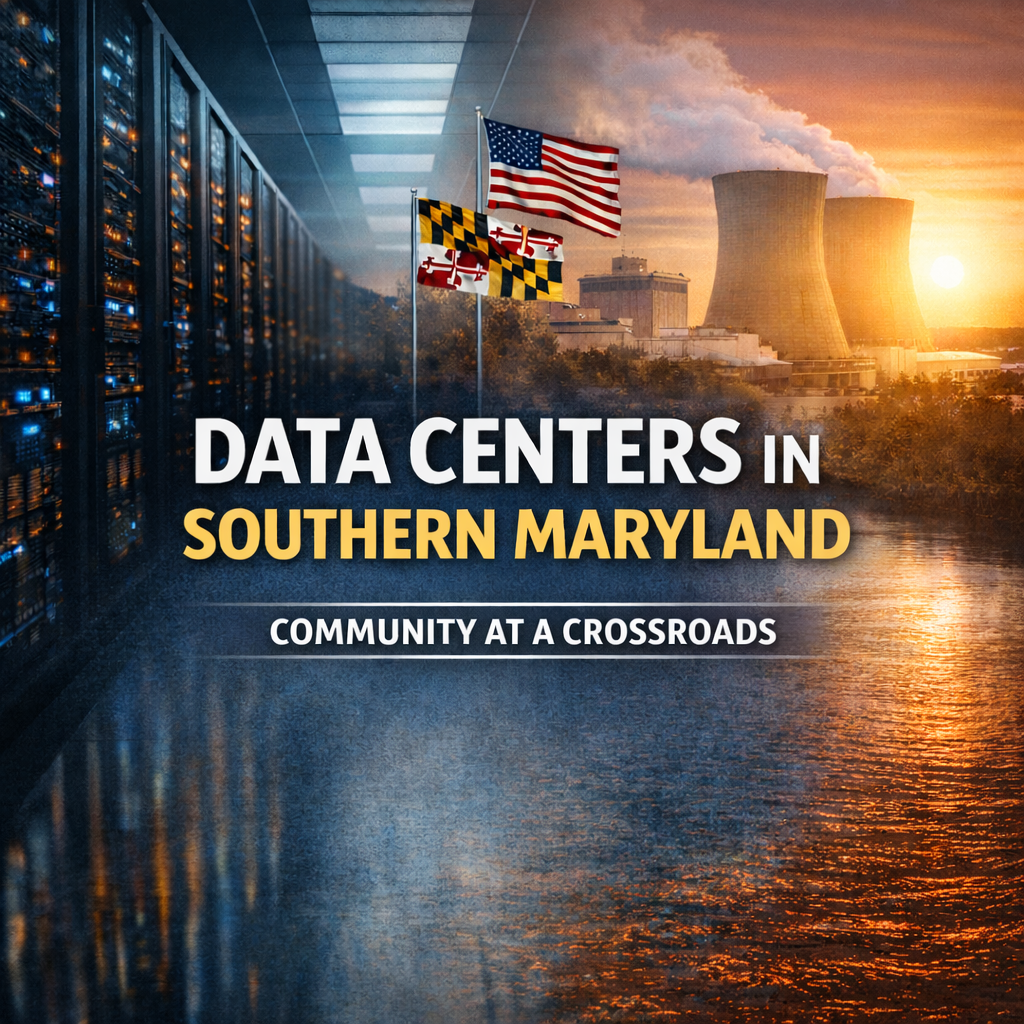
Southern Maryland Weighs Data Center Growth Amid Tax Breaks, Local Opposition and Legislative Pushback
Actions in Calvert and Charles counties could pave the way for data centers in both jurisdictions, even as some residents voice concerns and opposition. The issue is complex, with local and state governments attempting to regulate the industry while remaining open to the economic activity such projects could bring. At stake are tax incentives, zoning decisions and how public input is incorporated into the process.
In 2020, then-Gov. Larry Hogan (R) signed legislation offering qualified data centers a 10-year exemption on personal property taxes. The law allows data center operators to purchase equipment — including computers, desks and other infrastructure — tax-free, potentially saving large corporations millions of dollars.
At the time, then-Commerce Secretary Kelly Schulz said the program would help Maryland compete with neighboring states for “these lucrative projects.”
To qualify for the Maryland Data Center Tax Incentive Program, a company must create at least five qualified jobs within three years of applying and invest a minimum of $2 million or $5 million, depending on the project’s location.
Schulz, now CEO of the Maryland Tech Council, appeared on a Charles County government podcast Feb. 1 and described the origins of the legislation. She said that during a 2019 trip to the West Coast to recruit data center companies, she was told Maryland’s tax structure was a barrier. “Once you look at this reduction in your tax scheme, come back and talk to us,” she recalled being told. The legislation passed the following year.
The Maryland Tech Council is a membership organization that supports technology and life sciences industries. Within it is the Data Center Alliance of Maryland, which says it works to inform and educate Marylanders about the potential contributions of the data center industry and to align public policy to advance it.
The alliance’s website highlights projected benefits of data center development, including increased state tax revenue, construction jobs and potential impacts on electricity pricing. It also states that environmental and operational concerns associated with data centers are often “misunderstood” or overstated.
Members of the alliance’s steering committee include representatives from government and industry. Southern Maryland members include Julie Oberg, director of economic development for Calvert County, who serves as co-chair, and Ralph Patterson II (D-Charles), vice president of the Charles County Board of County Commissioners.
On Feb. 2, TeraWulf Inc. announced it had acquired the Morgantown Generating Station, a grid-connected power generation facility near the Potomac River and the Governor Harry W. Nice Memorial Bridge. In a news release, the company said the purchase establishes its presence in the PJM market, the multistate electric grid serving Maryland and 12 other states.
While no specific development plans have been announced, the company cited the site’s proximity to the Washington metropolitan area and said it is suitable for “compute-intensive uses.” TeraWulf develops and operates industrial-scale data center infrastructure built for high-performance computing and bitcoin mining. The Morgantown site includes about 250 acres for potential expansion and the capacity for additional energy generation, raising the possibility that a data center could co-locate with the power plant.
Following the announcement, Charles County Commissioner B.J. Bowling (D-Charles) requested withdrawal of a proposed zoning text amendment related to data centers. The amendment is under review by the Planning Commission, which will make a recommendation to the county commissioners. A majority agreed to allow the Planning Commission process — which has included public input — to continue. The commissioners will ultimately decide whether to adopt any recommended changes.
Bowling and Commissioner Amanda Stewart (D-Charles) also expressed support for creating a task force to further study the issue and increase transparency.
In Calvert County, records obtained by Informed St. Mary’s show possible data center activity as well.
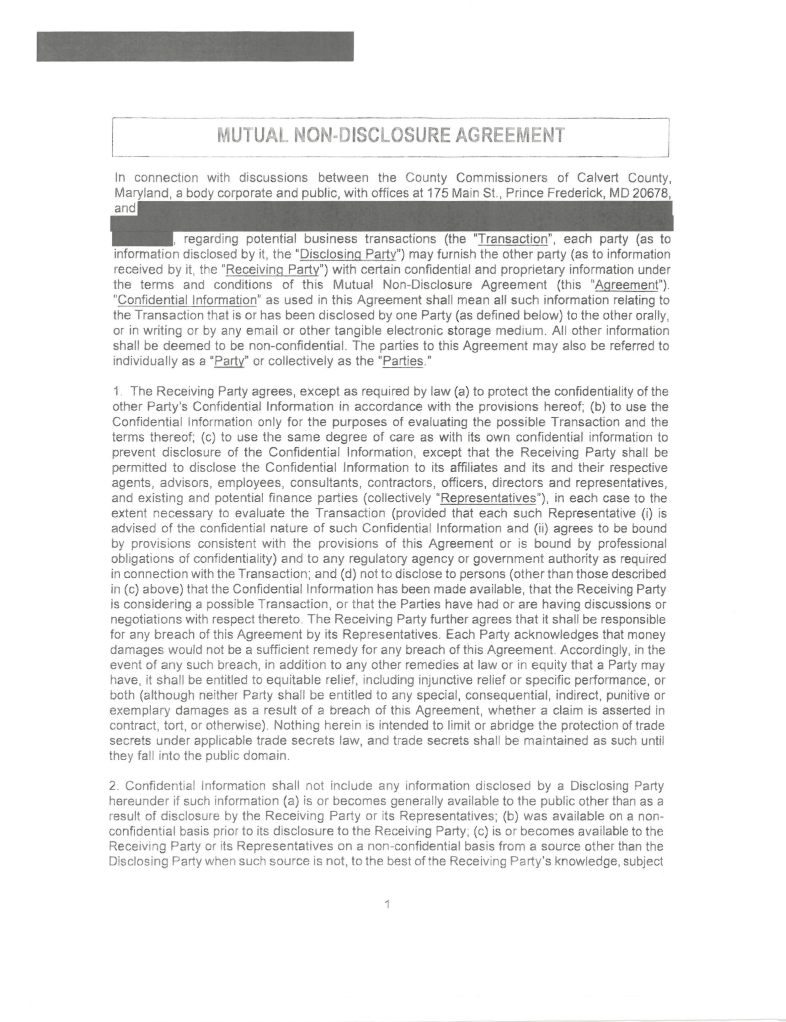
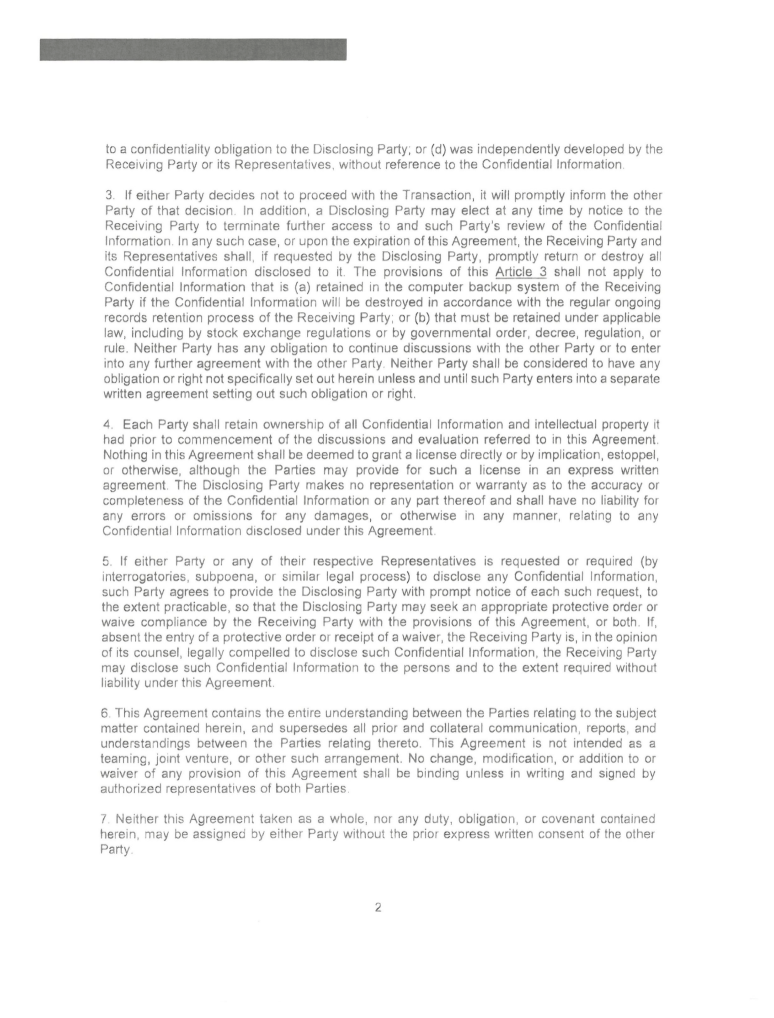
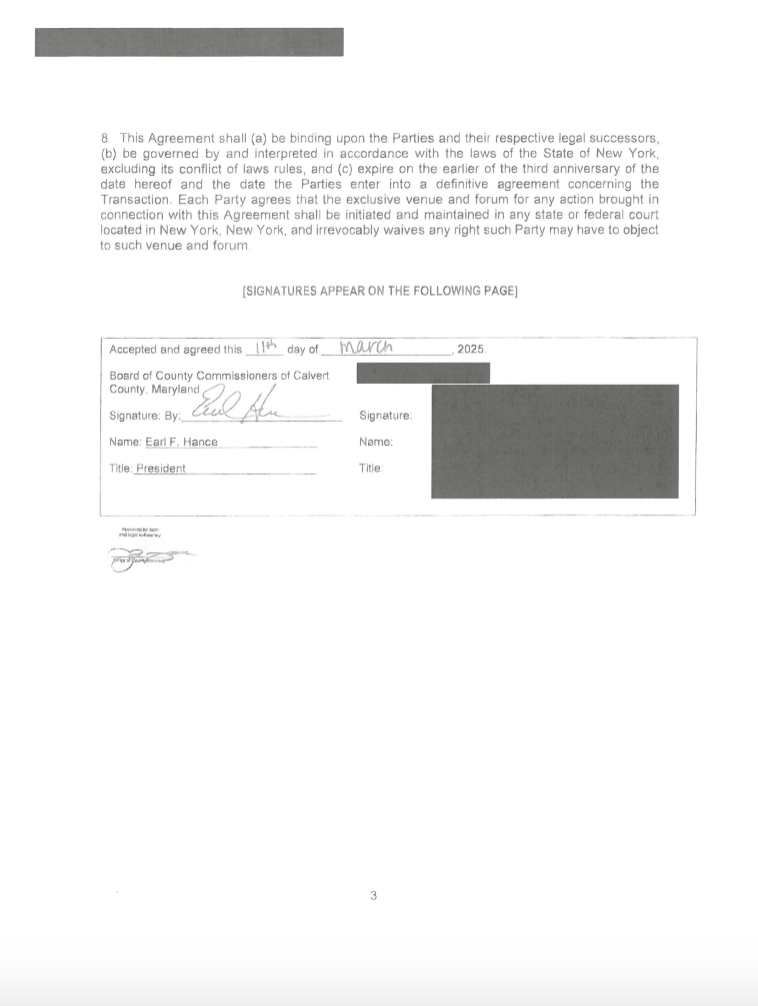
On March 11, 2025, Calvert County Commission President Earl “Buddy” Hance (R-Calvert) signed a nondisclosure agreement related to discussions about a potential project. The document, a standard NDA, has been redacted to obscure the other party’s identity.
Earlier, on March 1, 2025, the Calvert County commissioners adopted a zoning text amendment regulating where data centers are permitted. The amendment allows data centers in Light Industrial and Mixed Use districts and in the Heavy Industrial District. It outlines setback, design and noise mitigation requirements and requires applicants to hold a public meeting in the district where a project is proposed before Planning Commission review.
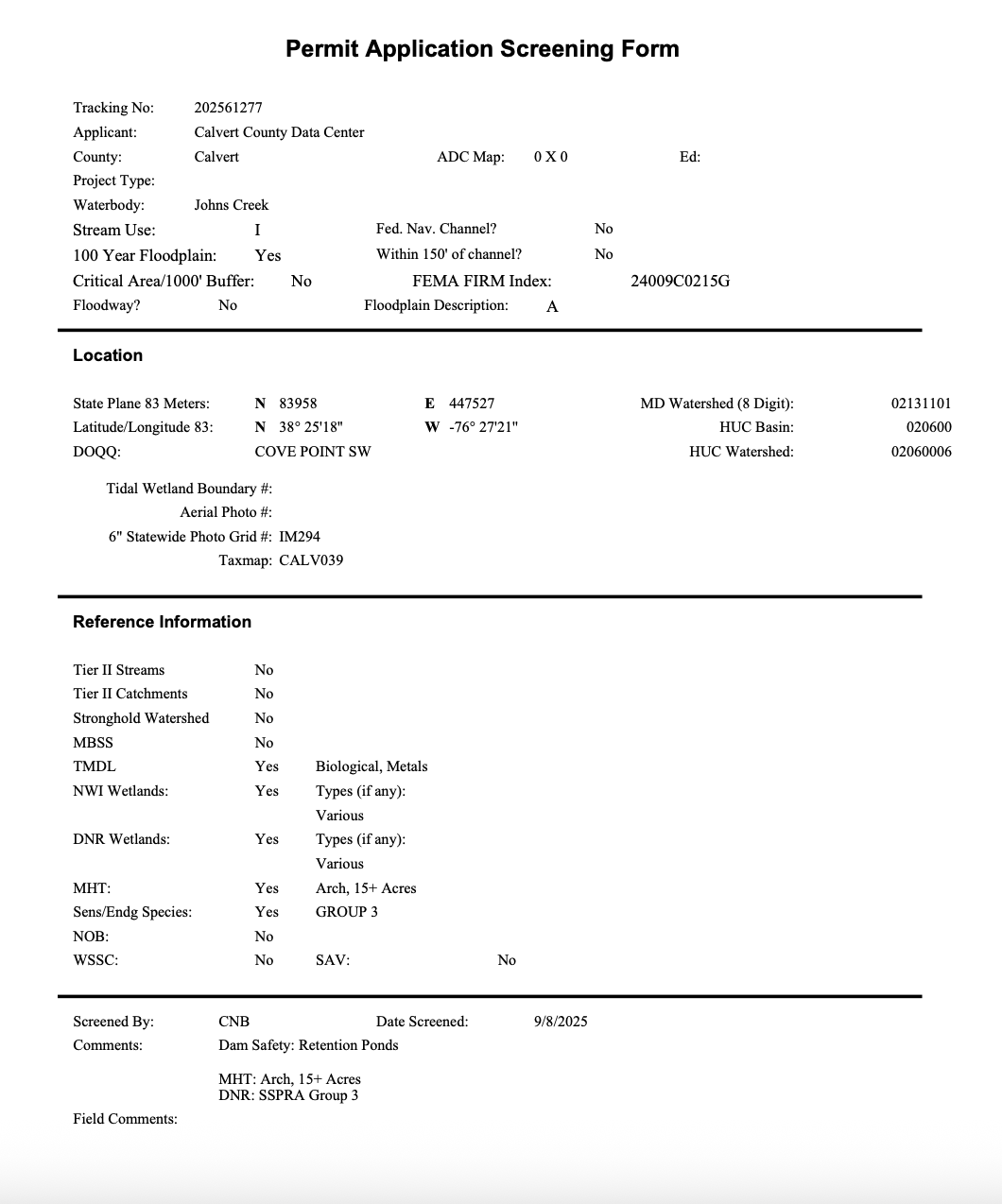
A December 2025 email between Calvert planning and zoning staff, with the subject line “Calvert County Data Center,” referenced a permit tracking number from the Maryland Department of the Environment. A search of that number on the agency’s website shows a pending permit application for “Minut Developers LLC – Data Center” at 1650 Calvert Cliffs Parkway in Lusby. The site, located along Johns Creek north of Southern Middle School, is in the Heavy Industrial District.
During their February 10 meeting, the Calvert County Commissioners reviewed a proposed amendment to the local zoning ordinance. Changes suggested would require closed-loop cooling, prohibit groundwater from use, and require collection of runoff for on-site cooling. It would also mandate any water, wastewater, stormwater, and roadway improvements be paid for by the data center developer. Additionally, if the data center has diesel generators they must meet U.S. EPA Tier 4 Final emission standards “where such certification is available for the applicable engine size/class.”
Meanwhile, several bills addressing data centers are pending in the General Assembly.
House Bill 560 would repeal the tax exemptions enacted in 2020. House Bill 120, introduced by Mark Fisher (R-Calvert), would establish a moratorium on data center development. The bill would become void if the General Assembly later passes legislation requiring projects to be co-located with an energy source — a provision that could apply to projects near Calvert Cliffs Nuclear Power Plant, where state permit records indicate development may be under consideration. Kelly Schulz, CEO of the Maryland Tech Council, spoke in opposition to Fisher’s bill.
As proposals advance in Charles and Calvert counties, the debate over data centers is moving from abstract policy to on-the-ground decisions that will shape Southern Maryland’s future. The outcome will depend not only on state incentives and corporate interest, but on how local officials balance economic ambitions with community priorities — and how actively residents engage in the process.
—————
Informed St. Mary’s remains paywall free for everyone with your support. Donate here to support this important work.