Comprehensive Plan - Draft Review
St. Mary's County is preparing for significant change over the next two decades.
According to the draft 2050 Comprehensive Plan, the county's population grew by approximately 45% between 1995 and 2020 and is expected to grow another 34% by 2045. State projections estimate nearly 39,000 additional residents could call St. Mary's home.
If growth is predicted to occur, the question becomes how, where and under what conditions it should happen. Spanning more than 200 pages, the draft Comprehensive Plan lays out a long-range vision for land use, housing, transportation, environmental protection, economic development and public infrastructure through 2050.
A comprehensive plan establishes the framework that guides future decisions. While it does not approve specific projects, it influences where development is encouraged, what infrastructure investments are prioritized and how local officials evaluate land-use decisions. The plan is often directly quoted by developers to justify projects as fitting within the county’s growth goals.
A public hearing on the draft plan is scheduled for Monday, June 29, at 6:30 p.m. before the St. Mary's County Planning Commission in Leonardtown. The hearing is a significant opportunity to shape the county's long-term future before the document advances to the County Commissioners.
Feedback for the draft plan overwhelmingly calls for growth to be managed rather than unrestricted. Community engagement conducted during development of the plan identified six recurring themes:
Environmental protection and rural preservation.
Housing affordability and growth management.
Transportation and infrastructure.
Economic diversification and support for small businesses.
Community services and quality of life.
Public safety and governance.
Residents want to preserve the county's rural heritage while directing development into existing growth areas. Seventy-eight percent of survey respondents identified Development Districts and Town Centers as the most appropriate locations for future growth and redevelopment, provided infrastructure keeps pace.
The plan also shows strong public support for revitalizing aging commercial corridors and underutilized properties rather than continuing to expand development into rural areas. Residents specifically expressed concern about the proliferation of convenience stores and gas stations.
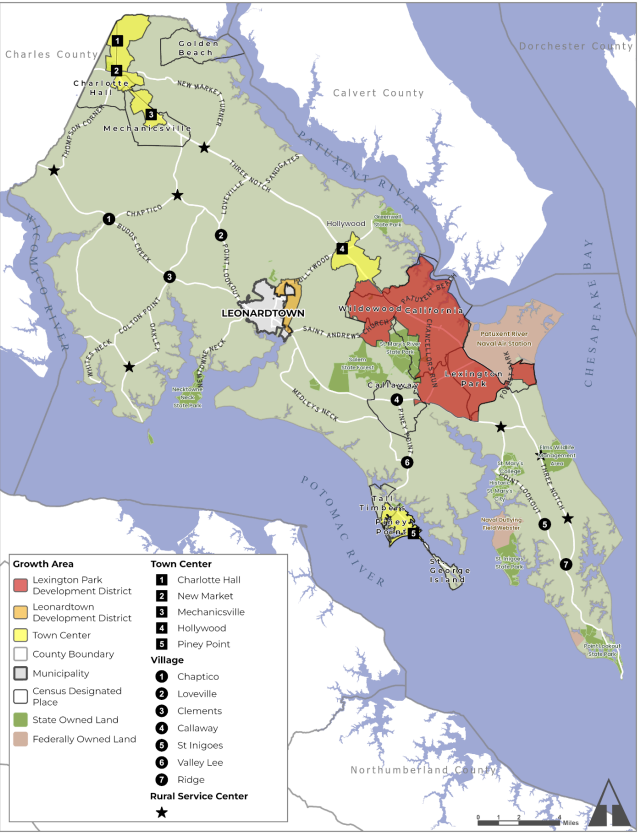
Map of Growth Areas
Development Districts are intended to accommodate the majority of future residential and commercial growth. These areas include Lexington Park and Leonardtown. The draft analysis indicates that Lexington Park alone could absorb roughly 85% of future development capacity within county growth areas. Higher residential densities are permitted here, and these areas are expected to contain the highest concentration of infrastructure. The plan encourages redevelopment, mixed-use projects, walkability and additional housing choices within these districts.
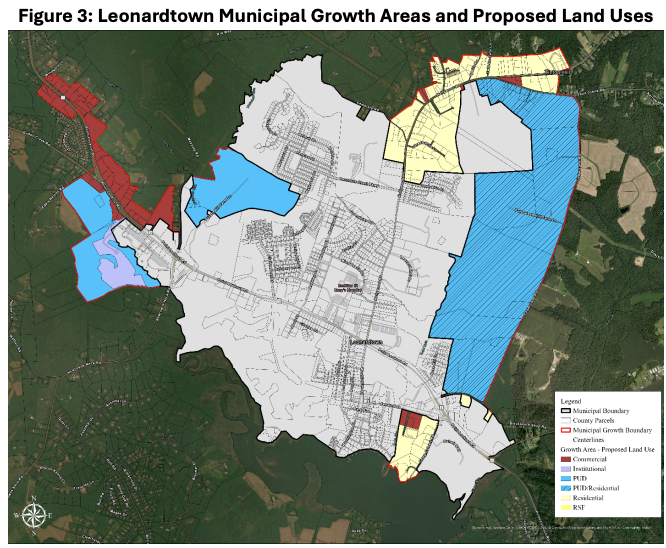
Leonardtown’s Growth Area, from the town’s Comprehensive Plan
Town Centers are intended to provide housing, services, employment and commercial activity at a moderate scale. These areas include Charlotte Hall, New Market, Mechanicsville, Hollywood, and Piney Point. The draft plan allows densities of up to five dwelling units per acre within Town Centers and calls for mixed-use, pedestrian-friendly design while discouraging strip development.
As written, the draft suggests but does not require that master plans be created for each Town Center. Without detailed master plans, questions remain regarding building design, traffic circulation, buffering between residential and commercial uses and the prevention of repetitive commercial development.
Village Centers — including communities such as Callaway, Chaptico, Clements, Loveville, Ridge, Valley Lee and St. Inigoes — are envisioned as locations for moderate residential growth combined with low-intensity commercial services. Like Town Centers, the document proposes but does not require creating master plans for Village Centers.
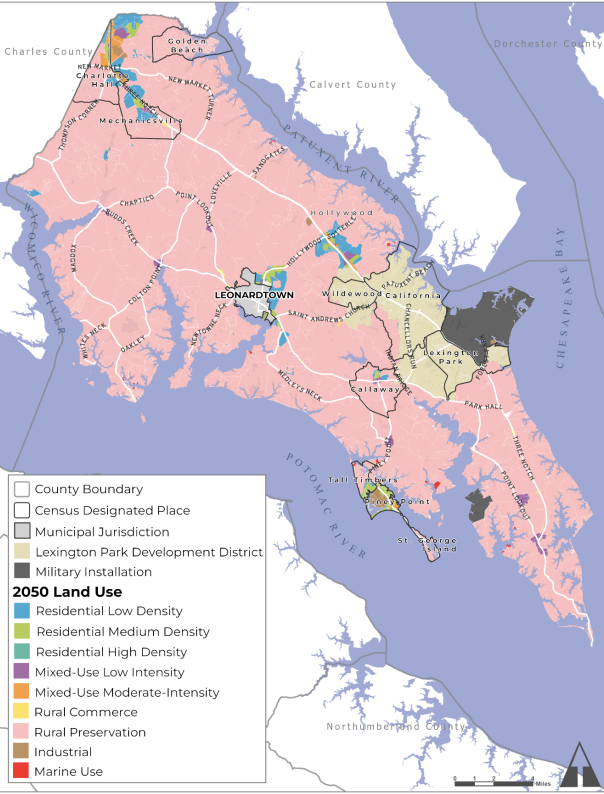
Proposed Zoning Map
Outside designated growth areas, the plan emphasizes preservation of rural landscapes. Support for agriculture and rural preservation emerged as one of the strongest themes during public outreach. The challenge will be ensuring future zoning changes remain consistent with these preservation goals.
Perhaps no issue receives more attention in the draft plan than housing affordability. Median home values increased from approximately $290,400 in 2013 to $403,900 in 2023, while the number of homes priced below $300,000 declined by 46% during the same period. Nearly 29% of homeowners and 45% of renters are considered cost-burdened, spending more than 30% of their income on housing costs.
The plan acknowledges younger residents, working families, seniors living on fixed incomes and many local employees struggle to find housing. To address those challenges, the draft proposes expanding "missing middle" housing options such as duplexes, triplexes, cottage courts and pocket neighborhoods. Residents also expressed strong support for smaller starter homes and townhouses.
One action in the plan calls on the county to “consider” creating an Attainable Housing Workgroup to oversee a proposed housing study. Like many areas of the plan, the action is a suggestion not a requirement. The county commissions have, in the past, expressed that a housing workgroup could be a waste of time.
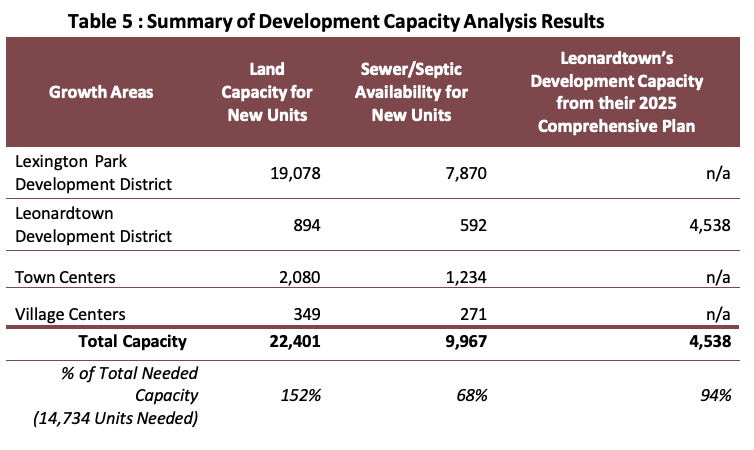
Development Capacity Analysis, from draft plan
While the draft promotes additional housing and redevelopment, infrastructure remains one of its most significant unresolved issues. Residents consistently expressed concern that development is outpacing roads, schools, public safety services and utility systems. Community members called for strengthening Adequate Public Facilities requirements to ensure infrastructure investments occur concurrently with development.
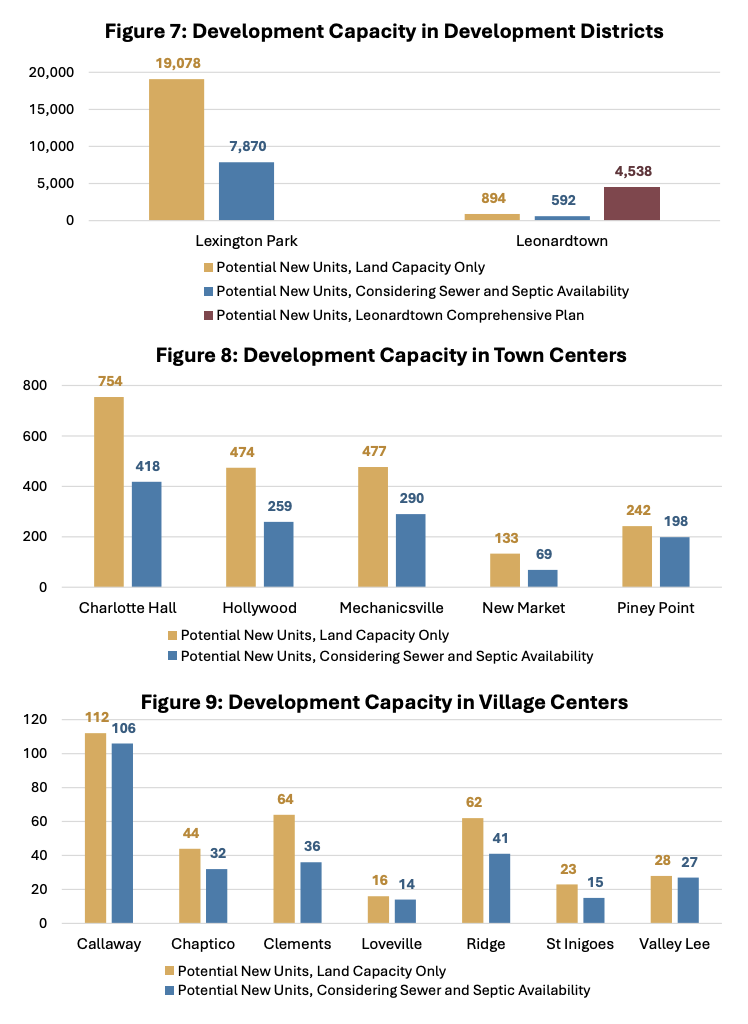
Development capacity by area, from draft plan
The draft proposes numerous infrastructure improvements, including:
Expanded water and sewer infrastructure within growth areas.
Potential use of modular wastewater systems in underserved communities.
Enhanced traffic management and corridor studies.
Additional sidewalks, trails and bicycle facilities.
Greater investment in recreation facilities, libraries and community services.
However, many proposed actions currently lack identified funding or staffing resources.
For example, just 51% of the action items identified on the plan’s implementation matrix have adequate resources to achieve the listed goal. How the county intends to prioritize, fund and monitor implementation of the plan's many recommendations remains unclear.
The draft 2050 Comprehensive Plan presents an ambitious vision for St. Mary's County. Whether that vision succeeds will depend not on the document itself, but on future decisions made by planners, elected officials and residents.
___________
Informed St. Mary’s remains paywall free for everyone with your support. Donate here to support this important work.