One in Four Marylanders Can’t Vote in the Primary

If you’re registered as an Independent or Unaffiliated voter in Maryland, you won’t be able to vote in this June’s primary election. Here’s why—and what options you still have.
Maryland operates under a closed primary system. That means only voters registered with a political party can participate in that party’s primary. In practice, that limits participation to Democrats and Republicans, the state’s two principal parties.
Unaffiliated voters make up a significant share of the electorate—nearly 1 million people, or about 25% of registered voters statewide. By comparison, roughly 2.2 million voters are registered as Democrats and about 1 million as Republicans. Unless those unaffiliated voters join a party, they cannot vote in primary elections.
State law makes it difficult for new political parties to form and maintain official recognition. To establish a party, at least 25 registered voters must file a constitution and bylaws with the state. Within two years, the group must also collect 10,000 petition signatures during either a presidential or gubernatorial election year. Even after qualifying, a party’s status is not permanent.
For example, a party that qualifies in 2024 would remain on the ballot through the next two statewide general elections, in 2024 and 2026, keeping its status through the end of 2026. To remain recognized beyond that point, the party’s candidate for the highest office on the ballot must receive at least 1% of the total vote. Alternatively, a party can maintain status if at least 1% of Maryland voters are registered with it. If those thresholds aren’t met, the party loses official recognition. These rules reinforce the two-party system in Maryland making it difficult for a third party to find success.
Candidates who are not affiliated with a recognized party can still run for office, but they face additional hurdles. Unaffiliated candidates do not appear on primary ballots and instead go straight to the general election. To qualify, they must file a declaration of intent to seek nomination by petition.
Signature requirements vary by office. A statewide candidate, such as for governor, must collect 10,000 signatures. For local offices like County Commissioner, candidates must gather signatures equal to 1% of registered voters in the district, with a minimum of 250.
Maryland also distinguishes between “principal” and “non-principal” parties. Principal parties are those whose candidates received the two highest vote totals for governor in the most recent election—typically Democrats and Republicans. Other recognized parties are considered non-principal and generally only appear on the general election ballot. The system discourages non-principal party candidates, and voters, from participating in the electoral process.
There is one exception for unaffiliated voters: nonpartisan races. Board of Education elections are nonpartisan, meaning all voters can participate. In St. Mary’s County this year, two Board of Education seats—District 1 and District 3—are on the ballot. Where more than two candidates file, all appear on the primary ballot and the top two advance to the general election. In District 1, two candidates filed, so both will move on to the general election. In District 3, only one candidate filed, effectively securing the seat.
For unaffiliated voters who want a say in primary contests, the only option is to register with a political party. That decision can shape where your vote has the most influence.
For example, the retirement of longtime Congressman Steny Hoyer has opened up Maryland’s 5th Congressional District. Of the more than 620,000 registered voters in the district, about 53% are Democrats, 23% are Republicans, and 22% are unaffiliated. Based on those numbers, the Democratic primary is likely the deciding race for the seat.
Locally, Democratic primary voters will also weigh in on races for County Commissioner District 1 and House of Delegates Districts 29B and 29C, all of which have multiple candidates.
On the Republican side, primary voters will decide contested races for Commissioner President, Commissioner Districts 2 and 4, and a challenge in Delegate District 29C. The Republican primary will also determine which candidate advances to face Gov. Wes Moore in the general election.
Voters can register or change their party affiliation through the Maryland State Board of Elections’ Voter Services website or in person at the St. Mary’s County Board of Elections in Leonardtown. The deadline to register or switch party affiliation in order to vote in the June 23 primary is June 2.
Primary elections are where parties narrow the field of candidates who will appear on the general election ballot. Participating at that stage gives voters an earlier opportunity to shape their choices—rather than selecting only from the final slate in November.
Broader participation in primaries can lead to more representative candidates, potentially reducing the influence of more ideologically extreme positions within either party. At the same time, the general election remains critical—especially at the local level. County commissioners, school board members, and state delegates make decisions that affect taxes, development, education, and public safety in ways that directly impact daily life.
Whether you choose to participate in a primary or wait until the general election, understanding when and how your vote has the most influence can help ensure your voice is part of those decisions.
The St. Mary’s County Board of Elections has begun mailing postcards to voters registered as unaffiliated to share information and options about how to participate. Those with questions can contact the local Board of Elections directly.
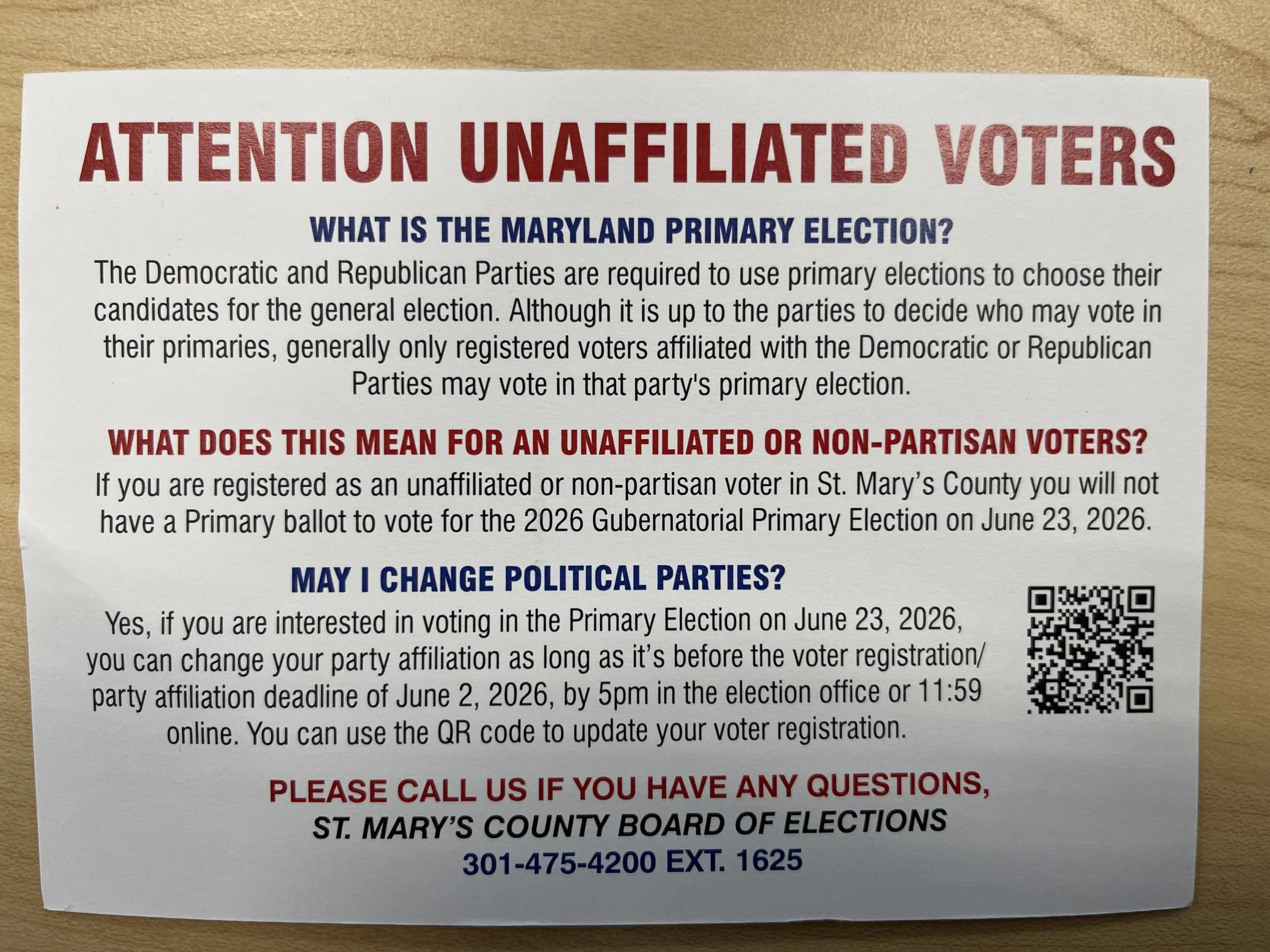
Board of Elections postcard
The St. Mary’s County Board of Elections has begun mailing postcards to voters registered as unaffiliated to share information and options about how to participate. Those with questions can contact the local Board of Elections directly.
—————
Informed St. Mary’s remains paywall free for everyone with your support. Donate here to support this important work.